> ## Documentation Index
> Fetch the complete documentation index at: https://patterns.heurilens.com/llms.txt
> Use this file to discover all available pages before exploring further.
# Competitor Analysis
> A measurable UX pattern where users compare experiences across alternatives and choose based on clarity, confidence, and reduced friction.
## Competitor analysis is about user decisions, not features
Users don’t compare roadmaps.
They compare **experiences**.
Competitor analysis in UX is not about who has more features —
it’s about **who feels easier, clearer, and safer to choose**.
Users rarely say “this competitor is better designed.”
They say: *this one feels simpler*, *this one makes sense faster*.
## Where competitive UX gaps actually appear
Competitor advantages are often invisible inside your own product.
They appear **only in contrast**.
Users may:
* understand your product
* like your product
* but still choose another
This usually means:
**the competitor reduces uncertainty earlier**.
 ## Observable user behavior tied to competitors
Competitive UX gaps leave strong signals.
Users leave to check alternatives after viewing pricing or features.
Users hesitate longer before choosing your product.
Users search for proof, reassurance, or validation before deciding.
These behaviors signal **relative weakness**, not absolute failure.
## What users compare — even when you don’t show it
Users always compare along invisible dimensions.
| Comparison dimension | User question |
| -------------------- | --------------------------------- |
| Clarity | Which one makes sense faster? |
| Effort | Which one feels easier to start? |
| Risk | Which one feels safer to choose? |
| Control | Which one feels more predictable? |
| Trust | Which one feels more legitimate? |
The winner is rarely the most powerful product.
It’s the one that **reduces cognitive risk first**.
## How competitor UX becomes measurable
Heurilens does not scrape competitors.
It measures **how users behave on your product when competitors exist**.
### Competitive UX signals include:
* exits after pricing exposure
* hesitation before signup
* feature comparison behavior
* scroll depth vs decision points
* abandonment near commitment steps
When these signals cluster, a **Competitive UX Gap** is flagged.
## How Heurilens evaluates competitive UX
The system identifies where users are most likely comparing alternatives.
Heurilens evaluates where reassurance is missing or delayed.
The system checks whether unique value is visible early enough.
Heurilens observes hesitation before irreversible actions.
## Example output from Heurilens
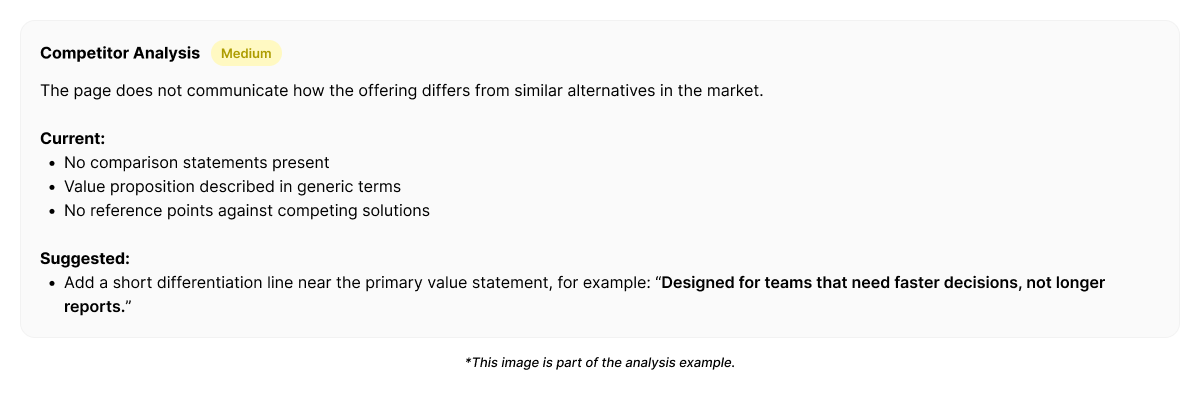
Users consistently hesitate before committing and exit after pricing exposure.
Competing products reduce uncertainty earlier through clearer positioning and trust signals.
## Common competitor analysis traps
Matching features does not close UX gaps.
Confidence beats completeness.
Copying layouts does not copy trust.
Context matters more than visuals.
Users don’t always choose cheaper.
They choose safer.
## Why competitor UX analysis matters
Competitive UX determines:
* win/loss at decision points
* perceived product maturity
* conversion efficiency
* long-term differentiation
Ignoring it leads to:
* silent churn
* marketing inefficiency
* endless feature chasing
Competitor UX gaps compound over time.
## Related patterns
Users compare within seconds of arrival.
Trust reduces comparative risk.
Competitors may align better with user mindset.
Search traffic often compares multiple options.
Run an analysis and understand why users choose — or leave — your product.
## Observable user behavior tied to competitors
Competitive UX gaps leave strong signals.
Users leave to check alternatives after viewing pricing or features.
Users hesitate longer before choosing your product.
Users search for proof, reassurance, or validation before deciding.
These behaviors signal **relative weakness**, not absolute failure.
## What users compare — even when you don’t show it
Users always compare along invisible dimensions.
| Comparison dimension | User question |
| -------------------- | --------------------------------- |
| Clarity | Which one makes sense faster? |
| Effort | Which one feels easier to start? |
| Risk | Which one feels safer to choose? |
| Control | Which one feels more predictable? |
| Trust | Which one feels more legitimate? |
The winner is rarely the most powerful product.
It’s the one that **reduces cognitive risk first**.
## How competitor UX becomes measurable
Heurilens does not scrape competitors.
It measures **how users behave on your product when competitors exist**.
### Competitive UX signals include:
* exits after pricing exposure
* hesitation before signup
* feature comparison behavior
* scroll depth vs decision points
* abandonment near commitment steps
When these signals cluster, a **Competitive UX Gap** is flagged.
## How Heurilens evaluates competitive UX
The system identifies where users are most likely comparing alternatives.
Heurilens evaluates where reassurance is missing or delayed.
The system checks whether unique value is visible early enough.
Heurilens observes hesitation before irreversible actions.
## Example output from Heurilens
Users consistently hesitate before committing and exit after pricing exposure.
Competing products reduce uncertainty earlier through clearer positioning and trust signals.
## Common competitor analysis traps
Matching features does not close UX gaps.
Confidence beats completeness.
Copying layouts does not copy trust.
Context matters more than visuals.
Users don’t always choose cheaper.
They choose safer.
## Why competitor UX analysis matters
Competitive UX determines:
* win/loss at decision points
* perceived product maturity
* conversion efficiency
* long-term differentiation
Ignoring it leads to:
* silent churn
* marketing inefficiency
* endless feature chasing
Competitor UX gaps compound over time.
## Related patterns
Users compare within seconds of arrival.
Trust reduces comparative risk.
Competitors may align better with user mindset.
Search traffic often compares multiple options.
Run an analysis and understand why users choose — or leave — your product.