> ## Documentation Index
> Fetch the complete documentation index at: https://patterns.heurilens.com/llms.txt
> Use this file to discover all available pages before exploring further.
# Persona Alignment
> A measurable UX pattern where the interface fails to match the user’s real goals, context, or decision mindset.
## Persona alignment is not who you designed for — it’s who actually shows up
Personas are often created in decks.
Persona alignment is tested **in real behavior**.
Users don’t adapt to products. Products either align with the user’s mindset — or create friction.
When alignment fails, users don’t feel “wrong persona.” They feel: *this is not for me*.
## Where persona mismatch silently appears
Persona mismatches rarely look like usability issues.
The interface may be clear. The flow may work.
But users still:
* hesitate despite clarity
* skip content that was “designed for them”
* avoid committing
* abandon after partial engagement
This is not confusion. This is **identity mismatch**.
## Observable user behavior signals
Persona misalignment leaves distinct behavioral traces.
Users ignore sections that are supposed to be core value drivers.
Users scroll and read but do not commit or progress.
Users leave after content that should have convinced them.
These signals indicate **misfit**, not disinterest.
 ## Common persona alignment failures
| Intended persona | What the interface assumes | What users actually need |
| ---------------- | -------------------------- | ------------------------ |
| Decision-maker | Fast answers | Risk reduction & proof |
| Explorer | Rich detail | Clear orientation |
| Buyer | Feature lists | Outcome clarity |
| Expert | Simplified language | Depth & precision |
When assumptions don’t match reality, friction multiplies.
## Persona alignment is measurable
Heurilens does not rely on declared personas.
It observes **how different user groups behave** on the same interface.
### Core alignment signals
* which content blocks are skipped
* which CTAs are ignored or delayed
* where hesitation clusters
* which paths are abandoned
* how long users stay without progressing
When these signals diverge from intended persona paths, a **Persona Alignment Breakdown** is flagged.
## How Heurilens evaluates persona alignment
The system infers dominant user intent from entry points and early behavior.
Heurilens checks whether key messages are consumed or bypassed.
The system evaluates whether users reach commitment moments confidently.
Divergence between expected and observed behavior is identified.
## Example output from Heurilens
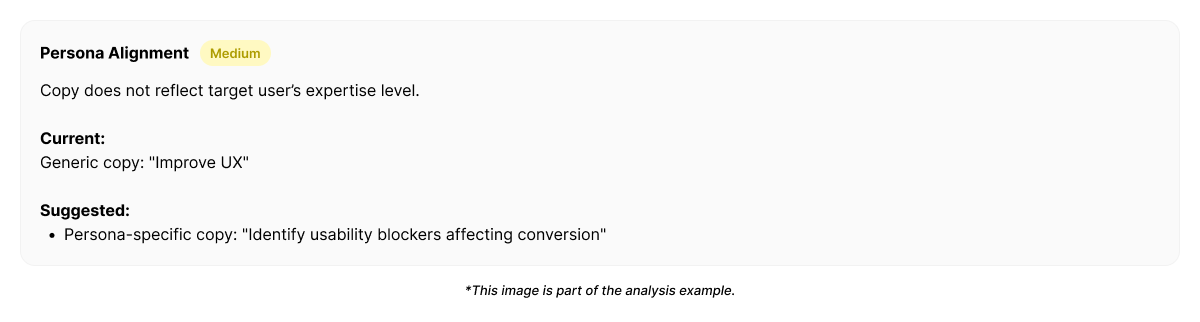
Users engage with surface content but fail to progress toward expected outcomes.
Key value propositions do not resonate with the dominant user intent on this page.
## Typical persona misconceptions
Knowing your audience does not guarantee alignment.
Behavior always has the final word.
Mixed audiences amplify friction.
Interfaces must signal who they are for.
User intent shifts by context, timing, and urgency.
## Why persona alignment matters
Persona alignment determines:
* trust formation speed
* clarity of value
* confidence to commit
* long-term retention
Misalignment doesn’t break UX immediately. It **erodes relevance** over time.
That makes it one of the most expensive UX failures to ignore.
## Related patterns
Language signals who the product is for.
Users follow paths that match their intent.
Flows must align with user narratives.
Emotional cues validate user identity.
Run an analysis and see whether your product truly speaks to the users who arrive.
## Common persona alignment failures
| Intended persona | What the interface assumes | What users actually need |
| ---------------- | -------------------------- | ------------------------ |
| Decision-maker | Fast answers | Risk reduction & proof |
| Explorer | Rich detail | Clear orientation |
| Buyer | Feature lists | Outcome clarity |
| Expert | Simplified language | Depth & precision |
When assumptions don’t match reality, friction multiplies.
## Persona alignment is measurable
Heurilens does not rely on declared personas.
It observes **how different user groups behave** on the same interface.
### Core alignment signals
* which content blocks are skipped
* which CTAs are ignored or delayed
* where hesitation clusters
* which paths are abandoned
* how long users stay without progressing
When these signals diverge from intended persona paths, a **Persona Alignment Breakdown** is flagged.
## How Heurilens evaluates persona alignment
The system infers dominant user intent from entry points and early behavior.
Heurilens checks whether key messages are consumed or bypassed.
The system evaluates whether users reach commitment moments confidently.
Divergence between expected and observed behavior is identified.
## Example output from Heurilens
Users engage with surface content but fail to progress toward expected outcomes.
Key value propositions do not resonate with the dominant user intent on this page.
## Typical persona misconceptions
Knowing your audience does not guarantee alignment.
Behavior always has the final word.
Mixed audiences amplify friction.
Interfaces must signal who they are for.
User intent shifts by context, timing, and urgency.
## Why persona alignment matters
Persona alignment determines:
* trust formation speed
* clarity of value
* confidence to commit
* long-term retention
Misalignment doesn’t break UX immediately. It **erodes relevance** over time.
That makes it one of the most expensive UX failures to ignore.
## Related patterns
Language signals who the product is for.
Users follow paths that match their intent.
Flows must align with user narratives.
Emotional cues validate user identity.
Run an analysis and see whether your product truly speaks to the users who arrive.