> ## Documentation Index
> Fetch the complete documentation index at: https://patterns.heurilens.com/llms.txt
> Use this file to discover all available pages before exploring further.
# SEO UX
> A measurable UX pattern where search visibility exists, but user intent is not satisfied after entry.
## SEO UX is what happens *after* the click
SEO success is often measured by rankings and traffic.
UX success begins **after the user arrives**.
SEO UX focuses on one critical question:
**Does the page fulfill the promise that brought the user here?**
If not, search traffic becomes noise — not value.
## Where SEO and UX silently break
SEO UX failures rarely look like technical SEO problems.
Pages may rank. Traffic may increase.
But users still:
* leave quickly
* scroll without engaging
* fail to take meaningful action
* return to search results
Search engines don’t see intent. **Users do.**
 ## Observable user behavior from search traffic
SEO UX breakdowns leave clear behavioral traces.
Users leave within seconds, often without scrolling.
Users scroll rapidly, scanning for expected information that never appears.
Users consume content but never commit or progress.
These behaviors indicate **intent mismatch**, not low-quality traffic.
## Common SEO UX failure patterns
| Search intent | What users expect | What breaks |
| ------------- | ------------------ | --------------------------- |
| Informational | Clear explanation | Overloaded or vague content |
| Commercial | Comparison & proof | Generic marketing language |
| Transactional | Clear next step | Hidden or weak CTAs |
| Navigational | Fast confirmation | Delayed clarity |
When intent is not met quickly, trust collapses.
## SEO UX is measurable — here’s how
Heurilens treats SEO UX as a **post-entry behavior pattern**.
It does not measure rankings. It measures **what users do after they arrive**.
### Core signals observed
* time to first meaningful interaction
* scroll depth vs content relevance
* exit points relative to key content
* action completion from search sessions
* repeated pogo-sticking behavior
When these signals align, an **SEO UX Breakdown** is flagged.
## How Heurilens evaluates SEO UX
The system evaluates whether above-the-fold content matches the dominant search intent.
Heurilens checks if promised information appears early and clearly.
The system observes whether users progress deeper or disengage quickly.
Heurilens evaluates whether users can take a logical next step after consuming content.
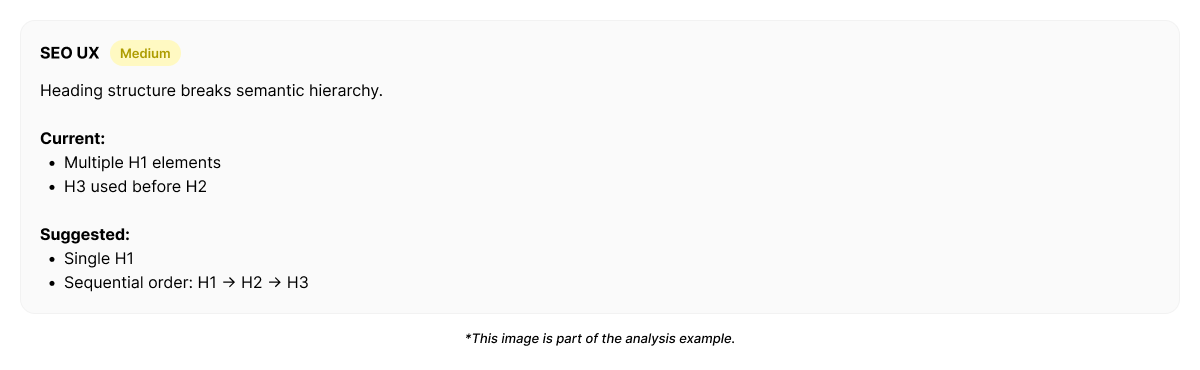
## Example output from Heurilens
Search traffic enters the page but fails to engage meaningfully.
Content does not align with dominant query intent, resulting in early exits and low conversion readiness.
## Typical SEO UX misconceptions
Traffic without engagement increases costs, not value.
Visibility is not usefulness.
Length without clarity increases frustration.
Users scan for relevance, not word count.
Technical SEO brings users in.
UX decides whether they stay.
## Why SEO UX matters
SEO UX sits at the intersection of **acquisition and experience**.
When it fails:
* marketing spend increases
* trust erodes before conversion
* growth appears healthy but performs poorly
SEO UX problems are dangerous because they look like success — until outcomes are measured.
## Related patterns
Search users decide faster than any other segment.
Search expectations rely heavily on scent cues.
Language defines relevance from the first sentence.
Overloaded pages repel intent-driven users.
Run an analysis and see whether your search traffic turns into real progress.
## Observable user behavior from search traffic
SEO UX breakdowns leave clear behavioral traces.
Users leave within seconds, often without scrolling.
Users scroll rapidly, scanning for expected information that never appears.
Users consume content but never commit or progress.
These behaviors indicate **intent mismatch**, not low-quality traffic.
## Common SEO UX failure patterns
| Search intent | What users expect | What breaks |
| ------------- | ------------------ | --------------------------- |
| Informational | Clear explanation | Overloaded or vague content |
| Commercial | Comparison & proof | Generic marketing language |
| Transactional | Clear next step | Hidden or weak CTAs |
| Navigational | Fast confirmation | Delayed clarity |
When intent is not met quickly, trust collapses.
## SEO UX is measurable — here’s how
Heurilens treats SEO UX as a **post-entry behavior pattern**.
It does not measure rankings. It measures **what users do after they arrive**.
### Core signals observed
* time to first meaningful interaction
* scroll depth vs content relevance
* exit points relative to key content
* action completion from search sessions
* repeated pogo-sticking behavior
When these signals align, an **SEO UX Breakdown** is flagged.
## How Heurilens evaluates SEO UX
The system evaluates whether above-the-fold content matches the dominant search intent.
Heurilens checks if promised information appears early and clearly.
The system observes whether users progress deeper or disengage quickly.
Heurilens evaluates whether users can take a logical next step after consuming content.
## Example output from Heurilens
Search traffic enters the page but fails to engage meaningfully.
Content does not align with dominant query intent, resulting in early exits and low conversion readiness.
## Typical SEO UX misconceptions
Traffic without engagement increases costs, not value.
Visibility is not usefulness.
Length without clarity increases frustration.
Users scan for relevance, not word count.
Technical SEO brings users in.
UX decides whether they stay.
## Why SEO UX matters
SEO UX sits at the intersection of **acquisition and experience**.
When it fails:
* marketing spend increases
* trust erodes before conversion
* growth appears healthy but performs poorly
SEO UX problems are dangerous because they look like success — until outcomes are measured.
## Related patterns
Search users decide faster than any other segment.
Search expectations rely heavily on scent cues.
Language defines relevance from the first sentence.
Overloaded pages repel intent-driven users.
Run an analysis and see whether your search traffic turns into real progress.