> ## Documentation Index
> Fetch the complete documentation index at: https://patterns.heurilens.com/llms.txt
> Use this file to discover all available pages before exploring further.
# Information Scent
> A measurable UX pattern where users follow — or abandon — paths based on how strongly links, labels, and cues signal what lies ahead.
## Information scent is how users choose where to go next
Users do not read interfaces. They **follow signals**.
Information scent is the perceived promise of what will happen *after* an action — before the action is taken.
A strong scent makes users confident. A weak scent makes users hesitate, guess, or leave.
## What breaks when information scent fails
When scent is weak or misleading, users:
* click, then immediately go back
* open links just to “check”
* hover without committing
* scan multiple options without choosing
* abandon paths early
These behaviors signal **expectation mismatch**, not curiosity.
## Observable behavior linked to scent issues
Information scent problems often appear as:
* immediate backtracking after navigation
* short dwell time on destination pages
* excessive hovering over links
* repeated comparison between options
* exits right after a click
Users are testing promises — and rejecting them.
 ## Where information scent matters most
Users rely on labels to predict content.
Weak scent:
* vague or generic wording
* overlapping meanings
* internal terminology
Result:
* users click, then retreat
CTAs promise outcomes.
Weak scent:
* action labels without result clarity
* identical CTAs leading to different outcomes
Result:
* hesitation before clicking
Links suggest relevance.
Weak scent:
* links that interrupt task intent
* unclear relationship to current context
Result:
* exploration without progression
## Scent breakdowns are measurable
Users do not say: “This label has weak information scent.”
Instead, Heurilens observes:
* click → immediate back
* click → short scroll → exit
* repeated comparison clicks
* stalled decision moments
* abandonment after exploration
When these signals cluster, an **Information Scent Breakdown** is flagged.
## How Heurilens evaluates information scent
Heurilens checks whether destination content matches the promise implied by the trigger.
The system evaluates whether wording clearly signals outcomes, not internal structure.
Heurilens analyzes whether similar labels lead to similar types of content and actions.
## Example output from Heurilens
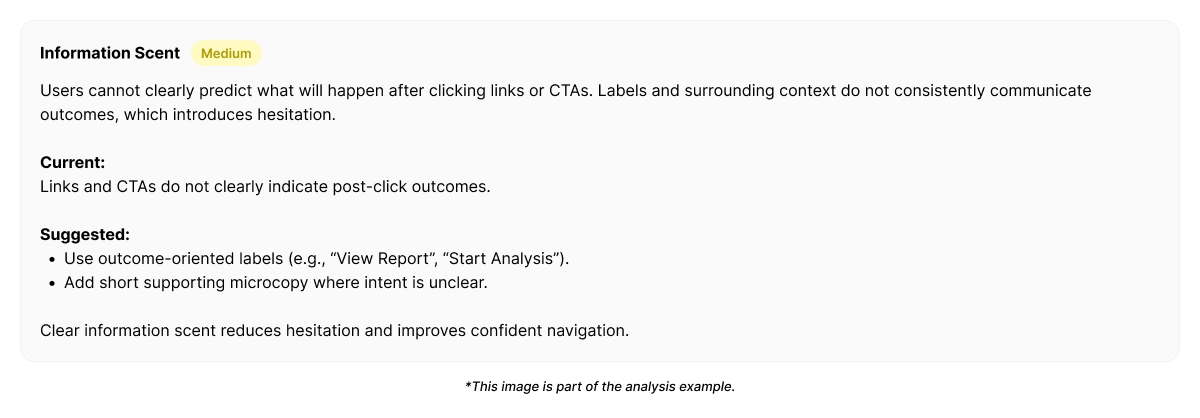
Users click links but return immediately to the previous page.
Link labels do not clearly communicate destination value, causing exploration without commitment.
## Example scent signals (simplified)
```json Scent mismatch example theme={null}
{
"pattern": "Information Scent Breakdown",
"trigger": "Pricing CTA",
"observed_behavior": [
"click_then_back",
"short_dwell_time",
"repeated_hover"
],
"likely_cause": "CTA label promises value explanation, but leads directly to purchase"
}
```
Strong information scent reduces the need for exploration. Users move forward because they trust the path.
## Why information scent matters
Information scent shapes:
* decision confidence
* navigation efficiency
* perceived complexity of the product
When scent is strong:
* users commit faster
* exploration feels purposeful
* flows feel shorter
When scent is weak:
* users hesitate
* paths feel risky
* trust erodes silently
## Related patterns
Structure supports predictable paths.
Scent keeps momentum alive.
Language defines expectations.
Visual cues amplify scent signals.
Run an analysis and identify where users follow — or abandon — your signals.
## Where information scent matters most
Users rely on labels to predict content.
Weak scent:
* vague or generic wording
* overlapping meanings
* internal terminology
Result:
* users click, then retreat
CTAs promise outcomes.
Weak scent:
* action labels without result clarity
* identical CTAs leading to different outcomes
Result:
* hesitation before clicking
Links suggest relevance.
Weak scent:
* links that interrupt task intent
* unclear relationship to current context
Result:
* exploration without progression
## Scent breakdowns are measurable
Users do not say: “This label has weak information scent.”
Instead, Heurilens observes:
* click → immediate back
* click → short scroll → exit
* repeated comparison clicks
* stalled decision moments
* abandonment after exploration
When these signals cluster, an **Information Scent Breakdown** is flagged.
## How Heurilens evaluates information scent
Heurilens checks whether destination content matches the promise implied by the trigger.
The system evaluates whether wording clearly signals outcomes, not internal structure.
Heurilens analyzes whether similar labels lead to similar types of content and actions.
## Example output from Heurilens
Users click links but return immediately to the previous page.
Link labels do not clearly communicate destination value, causing exploration without commitment.
## Example scent signals (simplified)
```json Scent mismatch example theme={null}
{
"pattern": "Information Scent Breakdown",
"trigger": "Pricing CTA",
"observed_behavior": [
"click_then_back",
"short_dwell_time",
"repeated_hover"
],
"likely_cause": "CTA label promises value explanation, but leads directly to purchase"
}
```
Strong information scent reduces the need for exploration. Users move forward because they trust the path.
## Why information scent matters
Information scent shapes:
* decision confidence
* navigation efficiency
* perceived complexity of the product
When scent is strong:
* users commit faster
* exploration feels purposeful
* flows feel shorter
When scent is weak:
* users hesitate
* paths feel risky
* trust erodes silently
## Related patterns
Structure supports predictable paths.
Scent keeps momentum alive.
Language defines expectations.
Visual cues amplify scent signals.
Run an analysis and identify where users follow — or abandon — your signals.