> ## Documentation Index
> Fetch the complete documentation index at: https://patterns.heurilens.com/llms.txt
> Use this file to discover all available pages before exploring further.
# Interaction Design
> A measurable UX pattern where feedback, timing, and response clarity determine whether users feel in control or disengaged.
## Interaction design is how the product responds to users
Interaction design is not how things look when idle.
It is how the product **reacts** when users:
* click
* type
* wait
* make mistakes
* try to understand what just happened
Every interaction answers a silent question:
**Did the system understand me?**
When that answer is unclear, users lose confidence — even if the action technically works.
## What breaks when interaction design fails
Interaction failures are rarely dramatic.
Users usually:
* click again “just in case”
* pause to confirm something happened
* hesitate before the next step
* repeat actions unnecessarily
* abandon flows after uncertainty
These behaviors signal **feedback failure**, not usability failure.
## Observable behavior linked to interaction issues
Interaction-related friction often appears as:
* repeated clicks on the same element
* rapid cursor movement after actions
* pauses after submissions
* users refreshing pages unnecessarily
* hesitation after state changes
These are signs that users are **waiting for confirmation**.
 ## Where interaction design matters most
Users expect immediate acknowledgment.
Signals:
* visible state change
* clear system response
* predictable timing
Common breakdown:
* actions succeed, but feel ignored
Users tolerate waiting if it feels intentional.
Signals:
* progress indication
* perceived system activity
* expectation setting
Common breakdown:
* silence during delays
Users need guidance, not punishment.
Signals:
* clarity of error cause
* recovery path visibility
* emotional tone
Common breakdown:
* errors that stop momentum
## How interaction breakdown becomes measurable
Users rarely say “the interaction felt wrong”.
Instead, Heurilens observes:
* action repetition patterns
* hesitation after state changes
* drop-offs immediately following interactions
* inconsistent progression through flows
* increased error retries
When these behaviors cluster, an **Interaction Design breakdown** is flagged.
## How Heurilens evaluates interaction design
Evaluates whether the system visibly acknowledges
user actions in a timely manner.
Assesses whether users can clearly understand
what changed after an interaction.
Analyzes whether responses arrive within
expected cognitive timeframes.
Evaluates whether users can recover smoothly
when interactions fail.
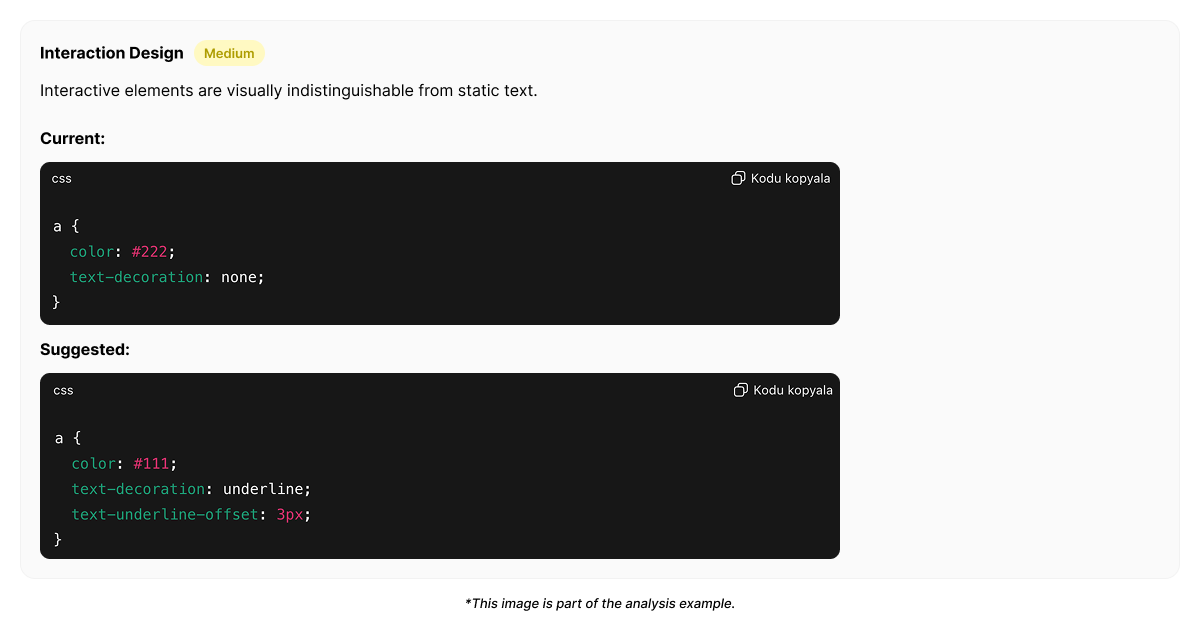
## Example output from Heurilens
Users repeat actions and hesitate after interactions.
System responses are delayed or unclear,
reducing confidence and flow continuity.
## Fix directions suggested by Heurilens
Heurilens does not prescribe animations or effects.
Instead, it highlights:
* where feedback is missing
* where timing feels inconsistent
* where system state is ambiguous
* where recovery paths are unclear
The goal is not richer interactions —
but **clearer communication between user and system**.
## Why interaction design matters
Interaction design defines whether users feel:
* in control
* understood
* safe to continue
When interactions fail, users slow down.
When they succeed, users stop thinking and move forward.
That makes interaction design a key driver of:
* flow continuity
* confidence
* conversion momentum
## Related patterns
Interaction clarity supports flow momentum.
Interaction feedback affects completion.
Feedback shapes emotional safety.
Unclear interactions increase mental effort.
Run an analysis and identify where interaction feedback breaks user confidence.
## Where interaction design matters most
Users expect immediate acknowledgment.
Signals:
* visible state change
* clear system response
* predictable timing
Common breakdown:
* actions succeed, but feel ignored
Users tolerate waiting if it feels intentional.
Signals:
* progress indication
* perceived system activity
* expectation setting
Common breakdown:
* silence during delays
Users need guidance, not punishment.
Signals:
* clarity of error cause
* recovery path visibility
* emotional tone
Common breakdown:
* errors that stop momentum
## How interaction breakdown becomes measurable
Users rarely say “the interaction felt wrong”.
Instead, Heurilens observes:
* action repetition patterns
* hesitation after state changes
* drop-offs immediately following interactions
* inconsistent progression through flows
* increased error retries
When these behaviors cluster, an **Interaction Design breakdown** is flagged.
## How Heurilens evaluates interaction design
Evaluates whether the system visibly acknowledges
user actions in a timely manner.
Assesses whether users can clearly understand
what changed after an interaction.
Analyzes whether responses arrive within
expected cognitive timeframes.
Evaluates whether users can recover smoothly
when interactions fail.
## Example output from Heurilens
Users repeat actions and hesitate after interactions.
System responses are delayed or unclear,
reducing confidence and flow continuity.
## Fix directions suggested by Heurilens
Heurilens does not prescribe animations or effects.
Instead, it highlights:
* where feedback is missing
* where timing feels inconsistent
* where system state is ambiguous
* where recovery paths are unclear
The goal is not richer interactions —
but **clearer communication between user and system**.
## Why interaction design matters
Interaction design defines whether users feel:
* in control
* understood
* safe to continue
When interactions fail, users slow down.
When they succeed, users stop thinking and move forward.
That makes interaction design a key driver of:
* flow continuity
* confidence
* conversion momentum
## Related patterns
Interaction clarity supports flow momentum.
Interaction feedback affects completion.
Feedback shapes emotional safety.
Unclear interactions increase mental effort.
Run an analysis and identify where interaction feedback breaks user confidence.