> ## Documentation Index
> Fetch the complete documentation index at: https://patterns.heurilens.com/llms.txt
> Use this file to discover all available pages before exploring further.
# User Flow
> A measurable UX pattern where users lose direction, confidence, or momentum across multi-step journeys — causing hesitation, looping, and drop-offs.
## What is a user flow in Heurilens?
A user flow is not a diagram of screens.
In Heurilens, a flow is defined as:
**Intent → Steps → Feedback → Next action**
Flow breaks when the user cannot confidently answer:
* Where am I right now?
* What just happened?
* What do I do next?
When those answers are unclear, users do not complain. They pause, backtrack, or abandon.
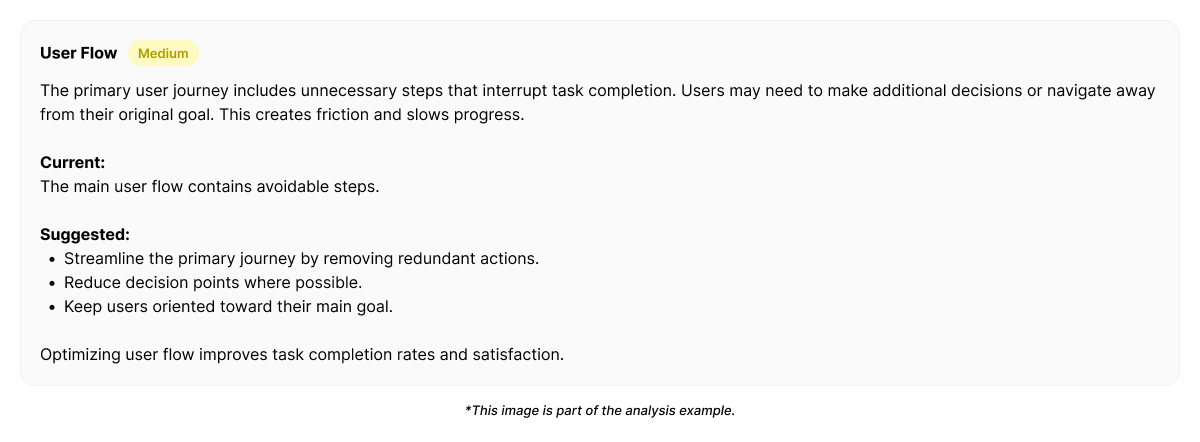 ## Flow breakdowns leave behavioral traces
Users slow down unexpectedly between steps, even when the UI is functional. This often appears as long pauses after a click, submit, or navigation event.
Users revisit the same pages or sections repeatedly. This suggests uncertainty about the correct path forward.
Users reach a point where there is no clear next step, recovery path, or confirmation. They often exit immediately after this moment.
Users believe they progressed, but the system state does not match expectation (e.g., form submits but no confirmation, filters reset, step not saved).
## Flow types Heurilens commonly evaluates
Typical intent: “Let me understand what this product offers.”
Common breakpoints:
* users skim without committing to a path
* repeated returning to the same sections
* unclear relationship between pages (features, pricing, FAQ)
Typical intent: “I’m ready to decide.”
Common breakpoints:
* hesitation near pricing, plan selection, or checkout
* back-and-forth between plan comparison and trust content
* drop-offs after form or payment steps
Typical intent: “Help me start without making mistakes.”
Common breakpoints:
* too much configuration too early
* unclear progress or step completion state
* missing feedback after a critical setup action
## How Heurilens detects flow issues
Heurilens identifies possible paths between key surfaces (entry → decision → action), based on navigation structure and CTA destinations.
The system evaluates whether each step provides: clear state, clear feedback, and a clear next action.
Heurilens flags flow breakpoints where multiple signals cluster: hesitation, loops, exits, and unclear feedback.
For each breakpoint, Heurilens generates: issue summary, impact, and fix direction tied to related modules.
## Example output from Heurilens (flow breakpoint)
Users reach a decision step but hesitate and backtrack repeatedly.
The next action is not visually or semantically confirmed, causing momentum loss and drop-offs.
```json Flow breakpoint (example output) theme={null}
{
"pattern": "User Flow Breakdown",
"breakpoint": "Plan selection → Checkout",
"signals": [
"long_pause_after_click",
"backtrack_to_pricing",
"exit_after_submit_attempt"
],
"likely_causes": [
"missing confirmation state",
"unclear next step label",
"trust cues appear too late"
],
"related_modules": [
"Interaction Design",
"Trust Signals",
"Forms CRO",
"Visual Hierarchy"
],
"severity": "high"
}
click("Select plan")
pause(6.2)
navigate("/pricing")
scroll(40%)
navigate("/checkout")
submit("form")
pause(4.1)
exit()
```
## Example fix direction (targeted)
Sometimes flow issues are not solved by adding more content. They are solved by making the transition moment unambiguous.
```css theme={null}
.checkout-step-indicator {
position: sticky;
top: 0;
font-weight: 600;
}
.primary-action {
min-height: 48px;
}
```
A good flow does not feel fast. It feels inevitable. Users should never need to re-decide what to do next.
## How this connects to other modules
Flow is not a standalone problem. A flow break usually comes from one of these sources:
* unclear feedback (Interaction Design)
* weak reassurance (Trust Signals, Emotional Design)
* unclear decision language (UX Writing)
* overwhelming step complexity (Cognitive Load)
* poor structural continuity (Information Architecture)
This is why Heurilens ties each breakpoint to the modules that explain the cause.
Run an analysis and identify where users lose momentum across journeys.
## Flow breakdowns leave behavioral traces
Users slow down unexpectedly between steps, even when the UI is functional. This often appears as long pauses after a click, submit, or navigation event.
Users revisit the same pages or sections repeatedly. This suggests uncertainty about the correct path forward.
Users reach a point where there is no clear next step, recovery path, or confirmation. They often exit immediately after this moment.
Users believe they progressed, but the system state does not match expectation (e.g., form submits but no confirmation, filters reset, step not saved).
## Flow types Heurilens commonly evaluates
Typical intent: “Let me understand what this product offers.”
Common breakpoints:
* users skim without committing to a path
* repeated returning to the same sections
* unclear relationship between pages (features, pricing, FAQ)
Typical intent: “I’m ready to decide.”
Common breakpoints:
* hesitation near pricing, plan selection, or checkout
* back-and-forth between plan comparison and trust content
* drop-offs after form or payment steps
Typical intent: “Help me start without making mistakes.”
Common breakpoints:
* too much configuration too early
* unclear progress or step completion state
* missing feedback after a critical setup action
## How Heurilens detects flow issues
Heurilens identifies possible paths between key surfaces (entry → decision → action), based on navigation structure and CTA destinations.
The system evaluates whether each step provides: clear state, clear feedback, and a clear next action.
Heurilens flags flow breakpoints where multiple signals cluster: hesitation, loops, exits, and unclear feedback.
For each breakpoint, Heurilens generates: issue summary, impact, and fix direction tied to related modules.
## Example output from Heurilens (flow breakpoint)
Users reach a decision step but hesitate and backtrack repeatedly.
The next action is not visually or semantically confirmed, causing momentum loss and drop-offs.
```json Flow breakpoint (example output) theme={null}
{
"pattern": "User Flow Breakdown",
"breakpoint": "Plan selection → Checkout",
"signals": [
"long_pause_after_click",
"backtrack_to_pricing",
"exit_after_submit_attempt"
],
"likely_causes": [
"missing confirmation state",
"unclear next step label",
"trust cues appear too late"
],
"related_modules": [
"Interaction Design",
"Trust Signals",
"Forms CRO",
"Visual Hierarchy"
],
"severity": "high"
}
click("Select plan")
pause(6.2)
navigate("/pricing")
scroll(40%)
navigate("/checkout")
submit("form")
pause(4.1)
exit()
```
## Example fix direction (targeted)
Sometimes flow issues are not solved by adding more content. They are solved by making the transition moment unambiguous.
```css theme={null}
.checkout-step-indicator {
position: sticky;
top: 0;
font-weight: 600;
}
.primary-action {
min-height: 48px;
}
```
A good flow does not feel fast. It feels inevitable. Users should never need to re-decide what to do next.
## How this connects to other modules
Flow is not a standalone problem. A flow break usually comes from one of these sources:
* unclear feedback (Interaction Design)
* weak reassurance (Trust Signals, Emotional Design)
* unclear decision language (UX Writing)
* overwhelming step complexity (Cognitive Load)
* poor structural continuity (Information Architecture)
This is why Heurilens ties each breakpoint to the modules that explain the cause.
Run an analysis and identify where users lose momentum across journeys.