> ## Documentation Index
> Fetch the complete documentation index at: https://patterns.heurilens.com/llms.txt
> Use this file to discover all available pages before exploring further.
# UX Risks
> A measurable UX pattern where hidden usability issues accumulate over time, silently reducing trust, efficiency, and conversion.
## UX risks are not bugs — they are delayed failures
Most UX risks do not break the product today.
They accumulate quietly:
* in hesitation
* in workaround behavior
* in repeated friction
* in declining confidence
By the time they are visible in metrics,
the cost has already been paid.
## Why UX risks are hard to notice
UX risks rarely trigger alarms.
They often:
* do not cause errors
* do not block completion
* do not generate support tickets
Instead, users adapt.
And adaptation hides problems.
> When users adapt, teams stop noticing friction.
## Observable behavior that signals UX risk
UX risks surface through patterns such as:
* gradual drop in completion rates
* longer time-on-task without clear reason
* increased retries that still succeed
* users avoiding certain features
* preference for manual or external workarounds
These behaviors indicate **systemic friction**, not isolated issues.
 ## Common categories of UX risk
The table below shows how different UX risks manifest over time:
| Risk type | Early signal | Long-term impact |
| --------------------- | ------------------ | ------------------ |
| Feedback ambiguity | Repeated actions | Loss of trust |
| Cognitive overload | Slower decisions | Abandonment |
| Inconsistent patterns | Learning resets | Reduced efficiency |
| Weak error recovery | Silent failures | Support dependency |
| Hidden complexity | Avoidance behavior | Feature underuse |
Each risk compounds others.
## Where UX risks concentrate
Small friction repeated many times
becomes a major productivity drain.
Uncertainty here reduces confidence
even when users proceed.
Rare but stressful moments
define perceived reliability.
Inconsistencies amplify confusion
across contexts.
## UX risk over time (conceptual)
1. **Initial tolerance**\
Users notice friction but proceed.
2. **Adaptation phase**\
Users change behavior to avoid friction.
3. **Silent cost accumulation**\
Efficiency and confidence decline.
4. **Outcome impact**\
Conversion, retention, or trust drops.
Most teams only react at step 4.
## How Heurilens identifies UX risks
Heurilens looks for repeated low-severity
friction signals across sessions and users.
The system correlates minor issues
across flows, devices, and modules.
Heurilens estimates long-term risk
based on frequency and context.
Risks are elevated from noise
into actionable insights.
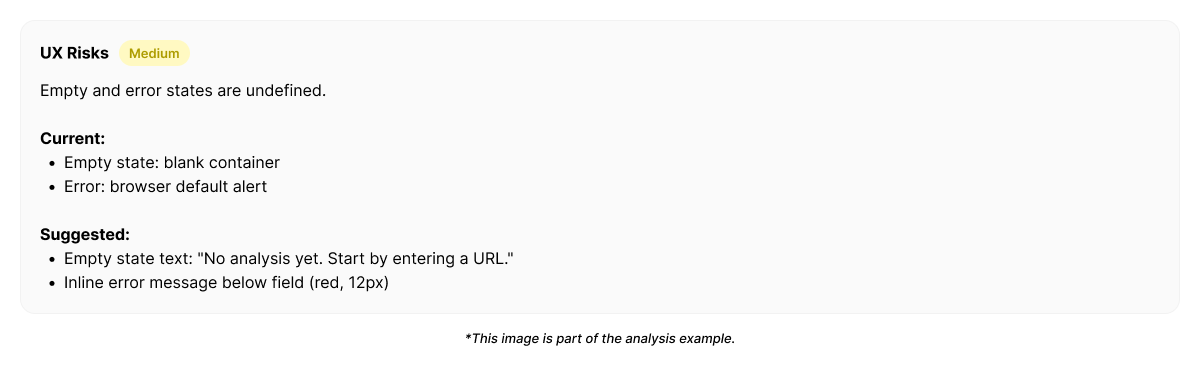
## Example output from Heurilens
Repeated minor interaction delays
indicate declining user confidence.
No single failure blocks progress,
but cumulative friction increases abandonment risk.
## Why UX risks matter
UX risks are expensive because:
* they scale with usage
* they erode trust invisibly
* they reduce long-term efficiency
* they delay growth signals
Teams often optimize features
while risks quietly undo those gains.
## Related patterns
Poor feedback accelerates risk accumulation.
Mental effort amplifies long-term friction.
Flow breaks create compounding risk.
Exclusion is a high-impact UX risk.
Run an analysis and uncover hidden risks before they compound.
## Common categories of UX risk
The table below shows how different UX risks manifest over time:
| Risk type | Early signal | Long-term impact |
| --------------------- | ------------------ | ------------------ |
| Feedback ambiguity | Repeated actions | Loss of trust |
| Cognitive overload | Slower decisions | Abandonment |
| Inconsistent patterns | Learning resets | Reduced efficiency |
| Weak error recovery | Silent failures | Support dependency |
| Hidden complexity | Avoidance behavior | Feature underuse |
Each risk compounds others.
## Where UX risks concentrate
Small friction repeated many times
becomes a major productivity drain.
Uncertainty here reduces confidence
even when users proceed.
Rare but stressful moments
define perceived reliability.
Inconsistencies amplify confusion
across contexts.
## UX risk over time (conceptual)
1. **Initial tolerance**\
Users notice friction but proceed.
2. **Adaptation phase**\
Users change behavior to avoid friction.
3. **Silent cost accumulation**\
Efficiency and confidence decline.
4. **Outcome impact**\
Conversion, retention, or trust drops.
Most teams only react at step 4.
## How Heurilens identifies UX risks
Heurilens looks for repeated low-severity
friction signals across sessions and users.
The system correlates minor issues
across flows, devices, and modules.
Heurilens estimates long-term risk
based on frequency and context.
Risks are elevated from noise
into actionable insights.
## Example output from Heurilens
Repeated minor interaction delays
indicate declining user confidence.
No single failure blocks progress,
but cumulative friction increases abandonment risk.
## Why UX risks matter
UX risks are expensive because:
* they scale with usage
* they erode trust invisibly
* they reduce long-term efficiency
* they delay growth signals
Teams often optimize features
while risks quietly undo those gains.
## Related patterns
Poor feedback accelerates risk accumulation.
Mental effort amplifies long-term friction.
Flow breaks create compounding risk.
Exclusion is a high-impact UX risk.
Run an analysis and uncover hidden risks before they compound.