> ## Documentation Index
> Fetch the complete documentation index at: https://patterns.heurilens.com/llms.txt
> Use this file to discover all available pages before exploring further.
# Emotional Design
> A measurable UX pattern where emotional cues influence confidence, comfort, and motivation — shaping user behavior beyond pure usability.
## Emotional design is not decoration
Emotional design is often mistaken for *visual delight*.
It is not about illustrations, gradients, or animations alone.\
It is about **how an interface makes users feel at critical moments** —\
and how that feeling affects their willingness to continue.
Users don’t only ask:
“Can I do this?”
They also ask, silently:
“Does this feel safe?”
“Does this feel right?”
“Am I confident continuing?”
## What breaks when emotional design fails
When emotional cues are misaligned, users may:
* technically understand the interface
* know what to do next
* still hesitate or disengage
This happens when the interface feels:
* cold or indifferent at high-effort moments
* overly aggressive at low-commitment moments
* playful when seriousness is expected
* silent when reassurance is needed
> Emotion fills the gap between clarity and confidence.
## Emotional signals users react to
Users subconsciously react to cues such as:
* tone of microcopy
* presence or absence of reassurance
* visual calm vs visual tension
* perceived effort vs perceived reward
* how mistakes are acknowledged
These signals shape **emotional safety**, not usability.
 ## Where emotional design matters most
Examples:
* pricing decisions
* checkout or payment steps
* irreversible actions
Emotional need:
* reassurance
* seriousness
* clarity without pressure
Common failure:
* cheerful or vague tone where certainty is expected
Examples:
* feature discovery
* onboarding
* first-time use
Emotional need:
* encouragement
* low pressure
* permission to explore
Common failure:
* overly formal or dense presentation
Examples:
* form errors
* failed actions
* empty states
Emotional need:
* calm guidance
* reduced blame
* clear recovery path
Common failure:
* harsh language
* silent failure
* technical messaging
## Observable behavior linked to emotional friction
Emotional design issues often show up as:
* hesitation despite clear instructions
* abandonment after small setbacks
* avoidance of irreversible actions
* reduced exploration of optional features
* users “giving up” earlier than expected
These behaviors indicate **emotional resistance**, not confusion.
## How Heurilens interprets emotional signals
Heurilens does not try to guess emotions.\
It correlates **interface moments** with **behavioral shifts**.
Signals include:
* drop-offs after errors
* pauses before high-risk actions
* reduced interaction after negative feedback
* increased exits after emotionally cold surfaces
When emotional cues fail to support intent, the pattern is flagged.
## Example output from Heurilens
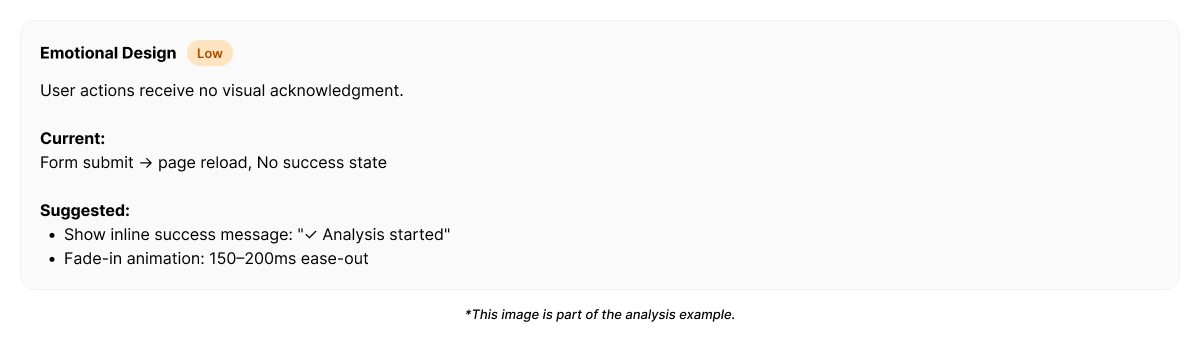
Users disengage at high-effort moments despite functional clarity.
The interface lacks reassurance and emotional grounding,
reducing confidence to proceed.
## Emotional fix directions (not visual rules)
Instead of “adding delight,” Heurilens suggests **emotional alignment**:
* match tone to commitment level
* acknowledge effort before asking for more
* reduce blame in error states
* reinforce progress and safety
* remove unnecessary pressure language
Emotional design works when users feel supported — not impressed.
## Why this pattern matters
Emotional design failures do not break usability.\
They break **momentum**.
Users may understand the interface perfectly\
and still decide not to continue.
This makes emotional design subtle, powerful, and easy to overlook
without behavioral measurement.
## Related patterns
Emotional cues directly influence behavior.
Emotional reassurance strengthens credibility.
Language sets emotional tone.
Overload amplifies emotional stress.
Run an analysis and see where emotional cues influence user behavior.
## Where emotional design matters most
Examples:
* pricing decisions
* checkout or payment steps
* irreversible actions
Emotional need:
* reassurance
* seriousness
* clarity without pressure
Common failure:
* cheerful or vague tone where certainty is expected
Examples:
* feature discovery
* onboarding
* first-time use
Emotional need:
* encouragement
* low pressure
* permission to explore
Common failure:
* overly formal or dense presentation
Examples:
* form errors
* failed actions
* empty states
Emotional need:
* calm guidance
* reduced blame
* clear recovery path
Common failure:
* harsh language
* silent failure
* technical messaging
## Observable behavior linked to emotional friction
Emotional design issues often show up as:
* hesitation despite clear instructions
* abandonment after small setbacks
* avoidance of irreversible actions
* reduced exploration of optional features
* users “giving up” earlier than expected
These behaviors indicate **emotional resistance**, not confusion.
## How Heurilens interprets emotional signals
Heurilens does not try to guess emotions.\
It correlates **interface moments** with **behavioral shifts**.
Signals include:
* drop-offs after errors
* pauses before high-risk actions
* reduced interaction after negative feedback
* increased exits after emotionally cold surfaces
When emotional cues fail to support intent, the pattern is flagged.
## Example output from Heurilens
Users disengage at high-effort moments despite functional clarity.
The interface lacks reassurance and emotional grounding,
reducing confidence to proceed.
## Emotional fix directions (not visual rules)
Instead of “adding delight,” Heurilens suggests **emotional alignment**:
* match tone to commitment level
* acknowledge effort before asking for more
* reduce blame in error states
* reinforce progress and safety
* remove unnecessary pressure language
Emotional design works when users feel supported — not impressed.
## Why this pattern matters
Emotional design failures do not break usability.\
They break **momentum**.
Users may understand the interface perfectly\
and still decide not to continue.
This makes emotional design subtle, powerful, and easy to overlook
without behavioral measurement.
## Related patterns
Emotional cues directly influence behavior.
Emotional reassurance strengthens credibility.
Language sets emotional tone.
Overload amplifies emotional stress.
Run an analysis and see where emotional cues influence user behavior.