
What is a First Impression Breakdown?
A First Impression Breakdown occurs when users cannot quickly understand:- what the product is
- who it is for
- what they should do next
It is a time-based perception failure that happens within the first few seconds of interaction. When first impressions fail, users don’t explore — they hesitate, scroll aimlessly, or leave.
Why first impressions are measurable
First impressions leave immediate behavioral traces. If users do not engage meaningfully at the top of the page, the issue is observable.Early hesitation
Early hesitation
Users pause without interacting, despite visible content.
Rapid scanning
Rapid scanning
Users scroll quickly before understanding what the page offers.
Immediate exits
Immediate exits
Users leave before any meaningful interaction occurs.
User behavior signals
A First Impression Breakdown is associated with signals such as:- delayed first interaction
- scrolling without engagement
- lack of clear focal attention
- early abandonment
Product-level signals
At the interface level, this pattern often appears alongside:- weak or unclear value proposition
- competing visual elements above the fold
- primary CTA lacking dominance
- excessive content density at entry point
How Heurilens detects this pattern
Above-the-fold structure
Above-the-fold structure
Heurilens evaluates layout hierarchy and visual focus in the initial viewport.
Attention distribution
Attention distribution
The system checks whether one clear element dominates initial attention.
Interaction readiness
Interaction readiness
Heurilens assesses whether a primary action is immediately recognizable.
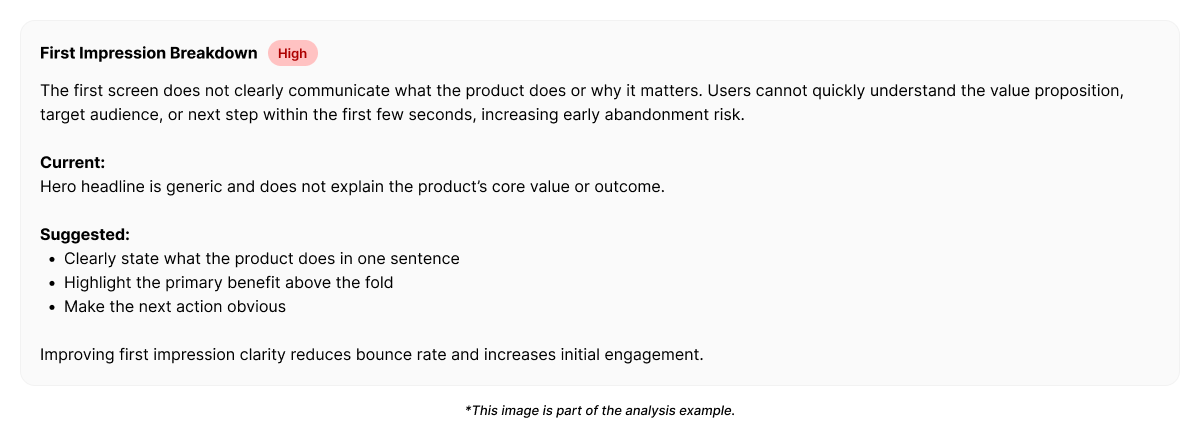
Example output from Heurilens
First Impression Breakdown Detected
Users are unable to clearly identify the primary value proposition and next action
within the first seconds of page load.The hero section lacks a dominant focal point, causing attention to fragment and
delaying the first meaningful interaction.
Example fix generated by Heurilens
Why this pattern matters
First impression issues rarely fail loudly.They fail silently and early. Users don’t complain.
They simply don’t continue. This makes the pattern especially dangerous — and especially important to detect.
Patterns commonly associated with this breakdown
Visual Hierarchy Failure
When multiple elements compete for initial attention.
Cognitive Load Spike
When too much information is presented too early.
Trust Signal Absence
When credibility cues are missing at entry point.
CTA Ambiguity
When the next step is unclear or visually weak.
First impressions are not subjective.
They are reflected in user behavior within seconds.Heurilens measures these signals to turn early uncertainty into actionable insight.
They are reflected in user behavior within seconds.Heurilens measures these signals to turn early uncertainty into actionable insight.
See this pattern detected on your product
Run an analysis and see how first impression breakdowns appear on real interfaces.