
Trust signals as measurable UX
Trust is not a feeling users articulate.It is a decision accelerator. When trust signals are present, users act faster.
When they are missing or weak, users hesitate — even if the offer is strong.
What breaks when trust signals fail
Trust breakdowns rarely look dramatic.They show up as small delays at critical moments. Common failure modes:
- credibility cues appear after the decision moment
- signals exist but lack clarity or relevance
- multiple weak signals compete instead of one strong cue
- design looks “polished” but unverified
Observable user behavior
“Users don’t say ‘I don’t trust this.’Behavioral traces include:
They simply don’t continue.”
- pauses before primary CTAs
- repeated scrolling around pricing or forms
- hovering over buttons without clicking
- exits from high-intent pages (pricing, signup, checkout)
How trust breaks across surfaces
- Pricing pages
- Forms & signup
- Feature pages
Typical issues:
- pricing shown without social proof
- guarantees hidden below the fold
- unclear refund or cancellation terms
- compare plans repeatedly
- leave to “think about it”
- seek reassurance elsewhere
Product-level signals Heurilens looks for
Heurilens evaluates trust at the moment of decision, not globally. Key checks:- presence of credibility cues near CTAs
- relevance of proof to the user’s intent
- clarity of guarantees, policies, and next steps
- consistency of trust cues across pages
- visual priority of the strongest signal
How Heurilens detects trust issues
1
Decision moment identification
Detects where users are expected to commit (signup, pricing, submit).
2
Signal proximity analysis
Checks whether trust cues appear before or after hesitation begins.
3
Signal strength evaluation
Assesses clarity, relevance, and dominance of trust indicators.
Example output from Heurilens
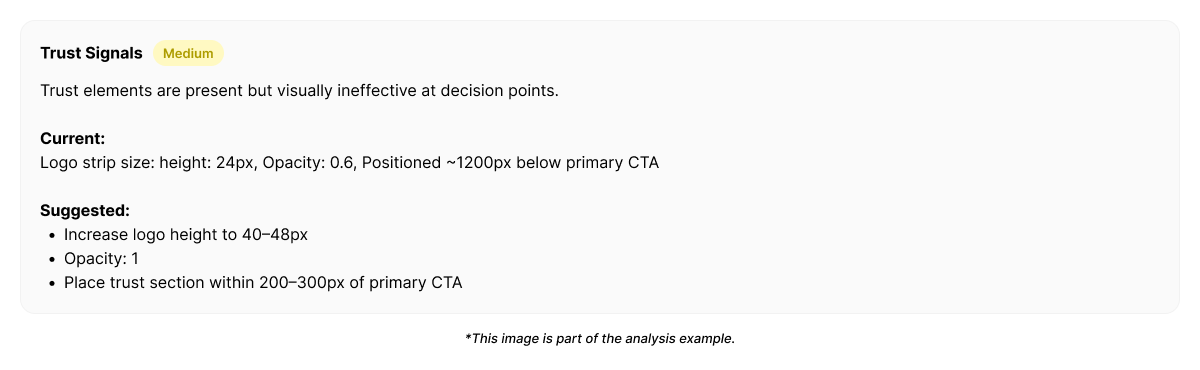
Trust Signal Weakness Detected
Primary actions lack immediate credibility reinforcement.Users hesitate at high-intent moments due to missing or delayed trust cues, reducing conversion confidence.
Example fix direction generated by Heurilens
Rather than adding “more badges,” Heurilens recommends better timing and focus:- place the strongest trust cue next to the decision
- replace generic proof with context-specific evidence
- explain why information is requested before asking
- clarify what happens immediately after action
- reduce competing trust messages to one dominant signal
Why this pattern matters
Trust failures do not reduce interest.They reduce commitment. Users want to proceed —
they just need confirmation that it’s safe and worth it.
Related patterns
First Impression Breakdown
Early clarity sets the baseline for trust.
Consistency
Predictable rules strengthen credibility.
Forms CRO
Forms amplify trust weaknesses.
Visual Hierarchy
Trust cues must visually dominate at the right moment.
Detect trust issues on your product
Run an analysis and see where users hesitate due to missing trust signals.