
UX writing as a UX signal
UX writing is not about tone alone.It is about decision clarity. When copy works, users move forward without thinking.
When it fails, users pause, reread, or abandon — even if the UI looks correct. This makes UX writing measurable through behavior, not opinion.
What breaks when UX writing fails
UX writing failures usually appear as:- vague or generic labels
- instructions that arrive too late
- actions that sound similar but do different things
- system messages that explain what happened but not what to do next
- reassurance copy missing at high-risk moments
They hesitate, make errors, or stop.
Observable user behavior
You’ll often see:- repeated hovering over buttons
- form errors caused by misunderstood fields
- users reading the same sentence twice
- delayed clicks on primary actions
- increased abandonment after error messages
When users reread, copy has already failed.
Where UX writing matters most
- Primary actions
- Forms & inputs
- System feedback
Typical issues:
- buttons labeled “Continue” without context
- multiple CTAs using similar language
- action labels that describe navigation instead of outcome
- hesitation before clicking
- wrong action selection
- backtracking
Product-level signals Heurilens looks for
Heurilens evaluates UX writing based on intent clarity, not style. Key checks include:- does the copy clearly describe the outcome of an action?
- is the user told what will happen next?
- does the copy reduce uncertainty at risky moments?
- are similar actions labeled consistently?
- does feedback guide the user forward?
How Heurilens detects UX writing issues
1
Decision point identification
Locates moments where users must commit, submit, confirm, or choose.
2
Copy–intent alignment
Compares labels and messages against the actual system outcome.
3
Hesitation correlation
Matches unclear copy with pauses, errors, and repeated interactions.
Example output from Heurilens
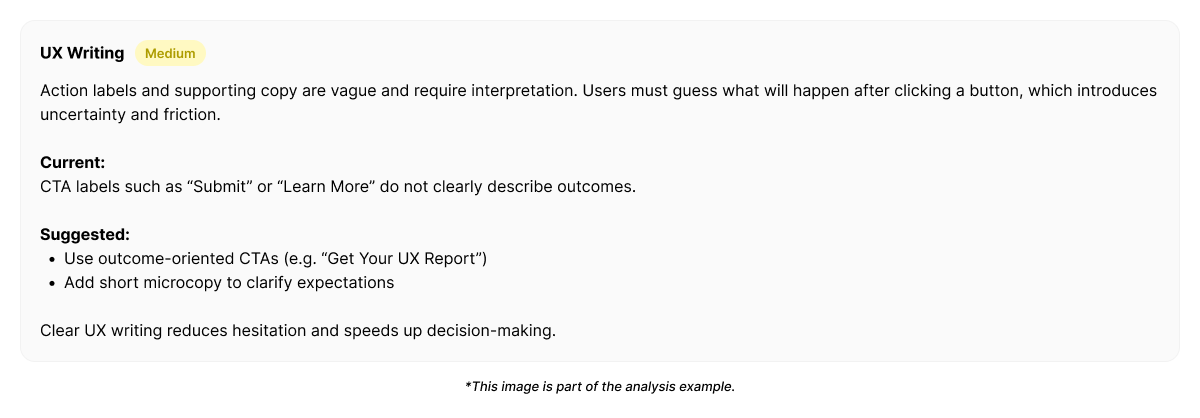
UX Writing Issue Detected
Action labels and helper text do not clearly communicate outcomes.Users hesitate at decision points and trigger avoidable errors due to unclear or generic copy.
Example improvement direction
Instead of “rewriting everything,” Heurilens suggests clarity-first adjustments:- replace vague labels with outcome-oriented language
- move critical instructions before the action
- clarify consequences of irreversible actions
- align similar actions with consistent wording
- add reassurance copy at high-risk moments
Why this pattern matters
UX writing failures rarely break flows completely.They slow users down and increase friction silently. Users still complete tasks —
just later, with more errors, or less confidence.
Related patterns
Trust Signals
Clear language reinforces credibility.
Forms CRO
Copy quality directly affects form completion.
Cognitive Load
Unclear wording increases mental effort.
Consistency
Inconsistent language breaks learned behavior.
See UX writing issues on your product
Run an analysis and see where unclear copy slows users down.