
Users arrive with a story already in mind
Users do not arrive as blank states. They arrive with:- a goal
- a context
- an assumption about how things should work
What breaks when user stories don’t match
User story mismatches are subtle. Users often:- follow the flow, but feel friction
- complete steps without confidence
- question whether they are “doing it right”
- slow down near decision points
- abandon despite understanding the interface
Observable behavior linked to story mismatch
When user stories and product flows diverge, behaviors include:- detours from the expected path
- skipping steps users feel are irrelevant
- backtracking to validate assumptions
- hesitation before committing actions
- abandoning after partial completion
Where user story alignment matters most
- First-time use
- Decision flows
- Problem-solving moments
Users are forming their initial mental model.Risk:
- the product assumes knowledge users don’t yet have
- steps appear out of order relative to user intent
- uncertainty disguised as exploration
Story mismatch is measurable
Users do not say: “This flow does not match my user story.” Instead, Heurilens observes:- skipped steps
- alternative path exploration
- pauses before irreversible actions
- repeated confirmation behaviors
- exits after partial success
How Heurilens evaluates story alignment
1
Intent inference
Heurilens infers likely user intent based on entry points, referrers, and early interactions.
2
Flow expectation mapping
The system evaluates whether the next steps match what a user with that intent would expect.
3
Confidence checkpoints
Heurilens checks whether reassurance, validation, or confirmation appears at the right moments.
4
Narrative continuity
The system assesses whether the flow maintains a consistent story from start to finish.
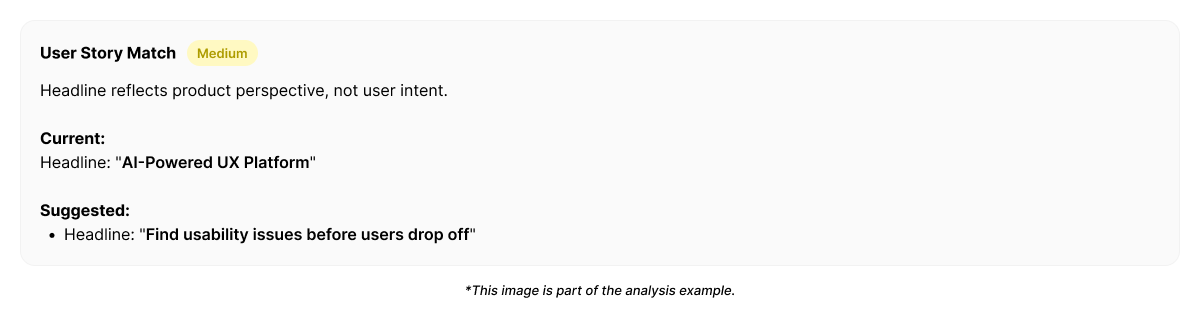
Example output from Heurilens
User Story Mismatch Detected
Users follow the flow but hesitate before completion.The product introduces steps that do not align with the user’s original intent and mental model.
Fix directions suggested by Heurilens
Heurilens does not suggest rewriting user stories. Instead, it highlights:- where the flow jumps ahead of user confidence
- where assumptions replace validation
- where context is missing
- where reassurance appears too late
Why user story match matters
When user stories align:- flows feel shorter
- decisions feel obvious
- users move forward without resistance
- even correct flows feel exhausting
- confidence erodes quietly
- conversion and retention suffer
Related patterns
User Flow
Flow continuity depends on narrative alignment.
Information Scent
Expectations guide story progression.
UX Writing
Language reinforces or breaks the story.
Emotional Design
Emotional cues validate the user’s role.
See user story mismatches on your product
Run an analysis and see where your product flow diverges from user intent.