
Forms are conversion surfaces, not input containers
Forms are where intent turns into commitment. Users don’t approach forms neutrally. They arrive with intent + doubt + limited patience. Every field, label, and interaction answers one silent question: “Is this worth completing?” Forms don’t fail because they are long. They fail because effort feels unjustified or unsafe.Where form conversion breaks
Form drop-offs rarely happen at the submit button. They happen when:- effort suddenly feels higher than expected
- the reason for a field is unclear
- errors feel punishing
- trust weakens mid-way
- progress feels invisible
Observable user behavior inside forms
Form-related friction shows up as:- focus without typing
- repeated field corrections
- pauses between fields
- scrolling up mid-form
- abandoning after the first error
- abandoning after partial completion
Common high-risk form moments
- Entry moment
- Mid-form friction
- Error & recovery
Users decide whether to start.Signals:
- field count visibility
- perceived effort
- clarity of purpose
- asking for commitment before value is clear
How form friction becomes measurable
Forms create some of the clearest behavioral signals in UX. Heurilens observes patterns such as:- abandonment after specific fields
- repeated validation loops
- exits after first error
- hesitation before submission
- reduced completion speed over time
How Heurilens evaluates form conversion
1
Effort perception
The system evaluates how demanding the form appears before users commit to completing it.
2
Clarity & justification
Heurilens checks whether each request feels justified in relation to user intent and context.
3
Error tolerance
Error handling is evaluated for tone, clarity, and ability to recover without loss.
4
Completion confidence
The system assesses whether users feel safe and certain submitting the form.
Example output from Heurilens
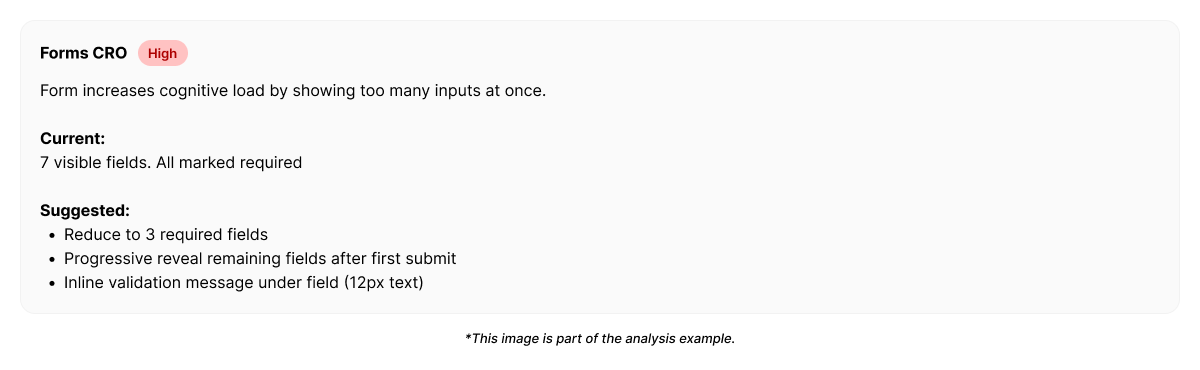
Form Conversion Friction Detected
Users abandon the form after initial engagement.Mid-form effort increases without sufficient justification, and error handling reduces confidence to continue.
Fix directions suggested by Heurilens
Heurilens does not suggest “shorter forms” by default. Instead, it highlights:- where perceived effort spikes
- where reassurance is missing
- where errors interrupt momentum
- where commitment is asked too early
Why Forms CRO matters
Forms sit at the narrowest point of conversion funnels. Small friction here:- doesn’t create complaints
- doesn’t create obvious UX bugs
- but silently kills outcomes
Related patterns
UX Writing
Language shapes form confidence.
Emotional Design
Emotional safety determines completion.
Trust Signals
Credibility reduces hesitation.
Cognitive Load
Overload increases abandonment.
See form friction on your product
Run an analysis and identify where your forms lose conversions.