
UX risks are not bugs — they are delayed failures
Most UX risks do not break the product today. They accumulate quietly:- in hesitation
- in workaround behavior
- in repeated friction
- in declining confidence
Why UX risks are hard to notice
UX risks rarely trigger alarms. They often:- do not cause errors
- do not block completion
- do not generate support tickets
When users adapt, teams stop noticing friction.
Observable behavior that signals UX risk
UX risks surface through patterns such as:- gradual drop in completion rates
- longer time-on-task without clear reason
- increased retries that still succeed
- users avoiding certain features
- preference for manual or external workarounds
Common categories of UX risk
The table below shows how different UX risks manifest over time:
Each risk compounds others.
Where UX risks concentrate
High-frequency actions
High-frequency actions
Small friction repeated many times
becomes a major productivity drain.
Critical decision points
Critical decision points
Uncertainty here reduces confidence
even when users proceed.
Edge-case recovery
Edge-case recovery
Rare but stressful moments
define perceived reliability.
Cross-device usage
Cross-device usage
Inconsistencies amplify confusion
across contexts.
UX risk over time (conceptual)
-
Initial tolerance
Users notice friction but proceed. -
Adaptation phase
Users change behavior to avoid friction. -
Silent cost accumulation
Efficiency and confidence decline. -
Outcome impact
Conversion, retention, or trust drops.
How Heurilens identifies UX risks
1
Signal accumulation
Heurilens looks for repeated low-severity
friction signals across sessions and users.
2
Pattern correlation
The system correlates minor issues
across flows, devices, and modules.
3
Impact projection
Heurilens estimates long-term risk
based on frequency and context.
4
Risk surfacing
Risks are elevated from noise
into actionable insights.
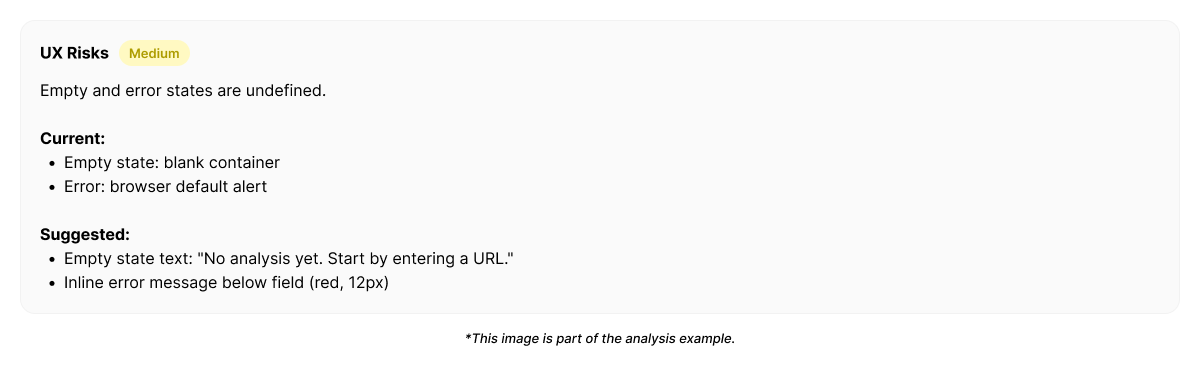
Example output from Heurilens
UX Risk Detected
Repeated minor interaction delays
indicate declining user confidence.No single failure blocks progress,
but cumulative friction increases abandonment risk.
Why UX risks matter
UX risks are expensive because:- they scale with usage
- they erode trust invisibly
- they reduce long-term efficiency
- they delay growth signals
Related patterns
Interaction Design
Poor feedback accelerates risk accumulation.
Cognitive Load
Mental effort amplifies long-term friction.
User Flow
Flow breaks create compounding risk.
Accessibility
Exclusion is a high-impact UX risk.
Surface UX risks on your product
Run an analysis and uncover hidden risks before they compound.